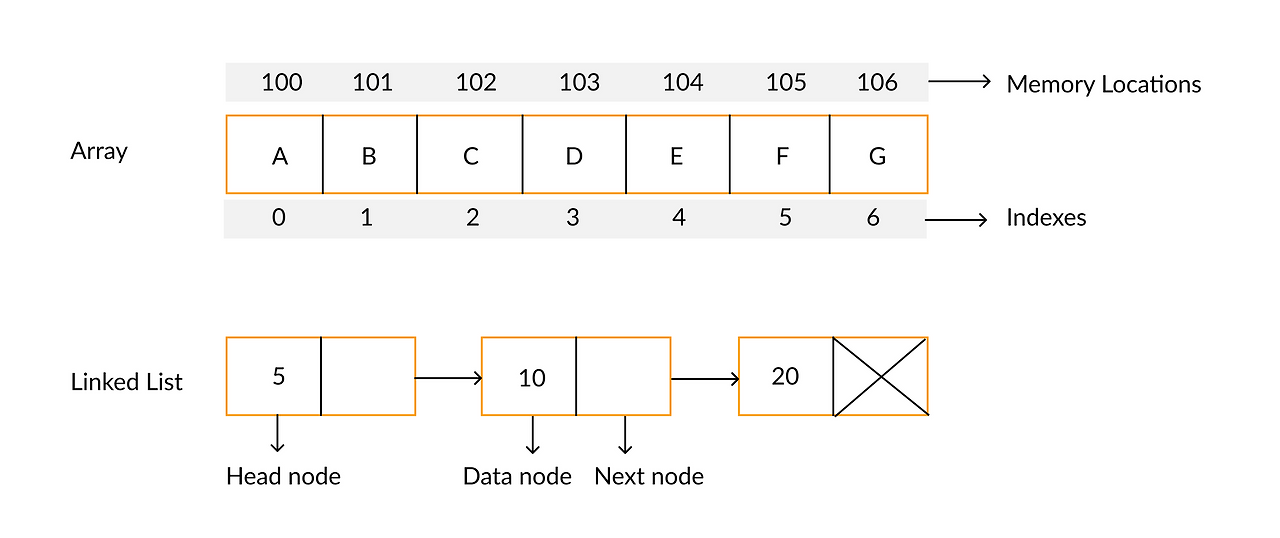
https://www.faceprep.in/data-structures/linked-list-vs-array/ 출처
링크드리스트(Linked List)는 데이터(노드)들이 포인터(참조)로 서로 연결된 자료구조입니다.
배열처럼 “칸”이 연속으로 붙어있는 게 아니라,
필요할 때 노드를 만들어 연결하는 방식이라서 삽입/삭제에 강한 편 입니다.
링크드리스트를 활용한 문제풀이
1) 구성요소
- Node(노드): 보통 값(value) + 다음(next)(필요하면 이전(prev)도) 로 구성
- Head(헤드): 첫 노드를 가리킴
- (옵션) Tail(테일): 마지막 노드를 가리킴
2) 종류
- 단일 연결 리스트(Singly): next만 있음
A → B → C → null - 이중 연결 리스트(Doubly): prev, next 둘 다 있음
null ← A ↔ B ↔ C → null - 원형 연결 리스트(Circular): 마지막이 다시 처음을 가리킴
A → B → C → A ...
3) 시간복잡도(핵심만)
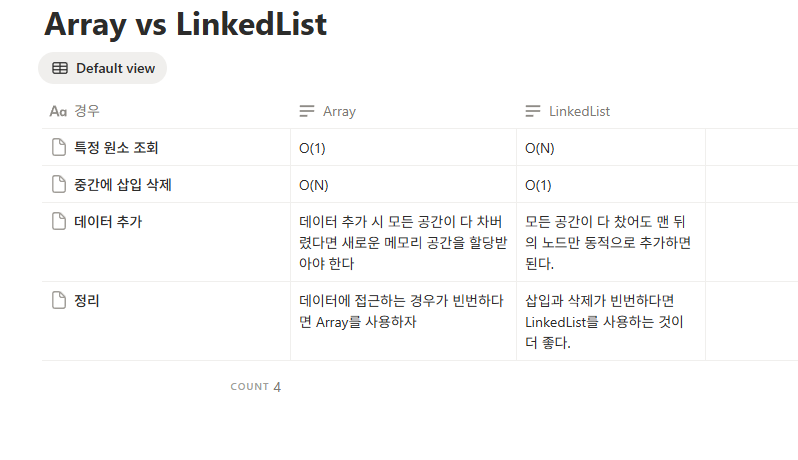
- 맨 앞 삽입/삭제: O(1)
- 특정 위치 삽입/삭제: 그 위치를 찾는 데 O(n) + 연결 바꾸는 건 O(1)
- 탐색(검색): O(n) (배열처럼 인덱스로 바로 못 감)
- 인덱스 접근: O(n)
4) 장단점
장점
- 중간에 끼워넣기/삭제가 비교적 쉬움(연결만 바꾸면 됨)
- 크기 가변(필요한 만큼만)
단점
- 접근/검색이 느림(O(n))
- 포인터 저장 공간이 추가로 듦
- 캐시 친화성이 떨어져 배열보다 느릴 때가 많음
5) 언제 쓸까
- 삽입/삭제가 잦고, 데이터 크기가 자주 변하는 경우
- 스택/큐 같은 구조를 링크드리스트로 구현할 때(특히 head 기준)
링크드 리스트를 활용한 문제를 풀어봤다
Linked List - append 함수 만들기
# ["시멘트"]

class Node:

        def __init__(self, data):
            self.data = data
            self.next = None

node = Node(3)
print(node.data, node.next)

next_node = Node(3)
node.next = next_node


class LinkedList:

    def __init__(self, value):
        self.head = Node(value)
#       LinkedList 의 가장 끝에 있는 노드에 새로운 노드를 연결해줘

    def append(self, value):
        cur = self.head

        while cur.next is not None:
            cur = cur.next

        cur.next = Node(value)
#       Linked_list 에서 저장한 head 를 따라가면서 현재 있는 노드들을 전부 출력해주는 함수.
    def print_all(self):
        cur = self.head
        while cur is not None:
            print(cur.data)
            cur = cur.next


linked_list = LinkedList(5)
print(linked_list.head.data)

linked_list.append(12)
# 5 -> 12
linked_list.append(8)
# 5 -> 12 -> 8

linked_list.print_all()
Linked list - 원소찾기
class Node:
    def __init__(self, data):
        self.data = data
        self.next = None


class LinkedList:
    def __init__(self, value):
        self.head = Node(value)

    def append(self, value):
        cur = self.head
        while cur.next is not None:
            cur = cur.next
        cur.next = Node(value)

    def print_all(self):
        cur = self.head
        while cur is not None:
            print(cur.data)
            cur = cur.next

    def get_node(self, index):
        cur = self.head
        cur_index = 0

        while cur_index != index:
            cur = cur.next
            cur_index += 1

        return cur

        return "index 번째 노드를 반환해보세요!"

linked_list = LinkedList(5)
linked_list.append(12)


print(linked_list.get_node(1).data) # -> 5를 들고 있는 노드를 반환해야 합니다!
두 링크드 리스트의 합 계산
class Node:
    def __init__(self, data):
        self.data = data
        self.next = None


class LinkedList:
    def __init__(self, value):
        self.head = Node(value)

    def append(self, value):
        cur = self.head
        while cur.next is not None:
            cur = cur.next
        cur.next = Node(value)

def get_single_linked_list_sum(linked_list):
    sum = 0
    cur = linked_list.head
    while cur is not None:
        sum = sum * 10 + cur.data
        cur = cur.next

    return sum


def get_linked_list_sum(linked_list_1, linked_list_2):
    sum_1 = get_single_linked_list_sum(linked_list_1)
    sum_2 = get_single_linked_list_sum(linked_list_2)

    # 구현해보세요!
    return sum_1 + sum_2


linked_list_1 = LinkedList(6)
linked_list_1.append(7)
linked_list_1.append(8)
# head를 가지고 시작한다.
# cur
# sum_1 = 6

#        cur
# sum_1 = 6 * 10 + 7 = 67

#                 cur
# sum_1 = 67 * 10 + 8 = 678 이렇게 노드 이동
# [6] -> [7] -> [8] linked_list 의 1을 구하는게 중요하다 이걸 어떻게 구할것이냐

linked_list_2 = LinkedList(3)
linked_list_2.append(5)
linked_list_2.append(4)
# [3] -> [5] -> [4]
print(get_linked_list_sum(linked_list_1, linked_list_2))'0️⃣Algorithm&자료구조&codingTest > Algorithm' 카테고리의 다른 글
| 06 - Stack & Queue (1) | 2025.12.26 |
|---|---|
| 05 - Sorting(정렬) (0) | 2025.12.26 |
| 04 - 재귀함수 (0) | 2025.12.25 |
| 03 - 이진탐색 (0) | 2025.12.16 |
| 01 - 알고리즘 (1) | 2025.12.08 |


